


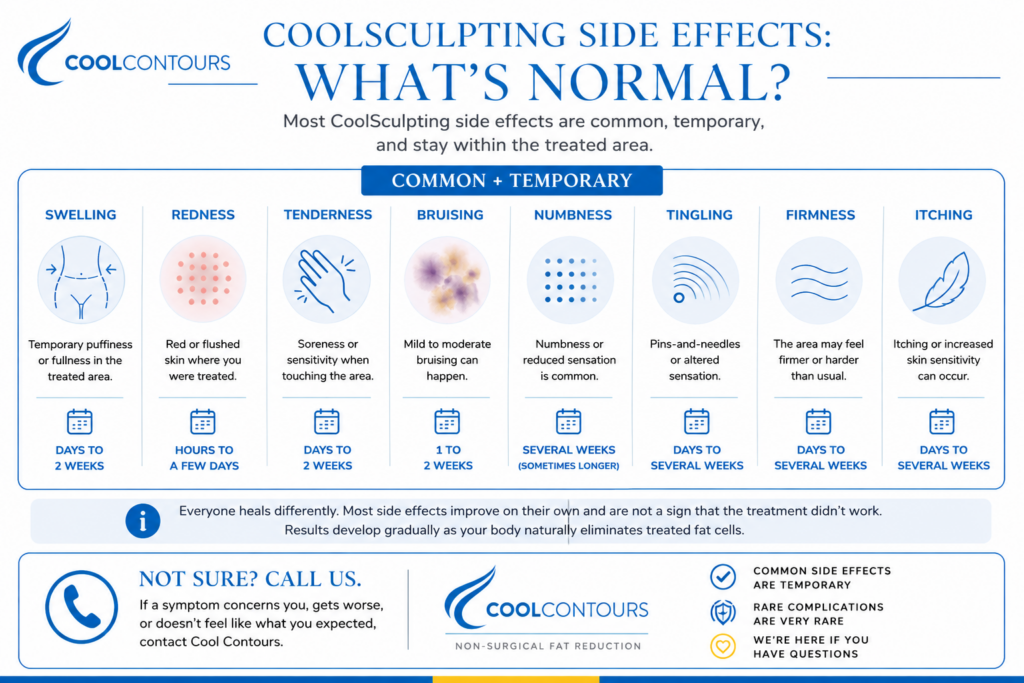
If your CoolSculpting treatment area feels swollen, numb, tender, firm, itchy, or just a little strange, you may be wondering whether what you’re experiencing is normal.
In most cases, CoolSculpting side effects stay within the treated area and improve on their own. Some disappear quickly. Others, especially numbness and changes in sensation, can last several weeks.
According to CoolSculpting’s current safety information, redness, firmness, bruising, swelling, tenderness, aching, itching, skin sensitivity, tingling, and numbness can all occur after treatment.
But you don’t need to diagnose yourself based on something you found online.
If something after your CoolSculpting treatment concerns you, call your provider. If you’re a Cool Contours patient, we want to hear from you.
Here’s what’s common after CoolSculpting, what may stick around a little longer, and when you should check in with your provider.
Quick Answer: What Are the Most Common CoolSculpting Side Effects?
CoolSculpting uses controlled cooling to target fat cells beneath the skin. During and after treatment, your tissue responds to the cooling, suction when a vacuum applicator is used, and the treatment itself.
That can cause temporary changes in the area.
| Side Effect | What You May Notice |
|---|---|
| Redness | Temporary redness around the treatment area |
| Swelling | Puffiness or temporary fullness |
| Tenderness | Soreness or sensitivity when touching the area |
| Numbness | Reduced or altered sensation |
| Tingling | Pins-and-needles or changing sensation |
| Bruising | Bruising around the treatment area |
| Firmness | The area may temporarily feel harder than usual |
| Itching | Itching or increased skin sensitivity |
These effects are generally temporary and may resolve within days or weeks. Changes in sensation, including numbness, can sometimes last longer.
Is Swelling Normal After CoolSculpting?
Yes. Swelling is an expected temporary side effect after CoolSculpting.
It can make the treated area look puffier or even temporarily larger than it did before treatment. That can feel a little counterintuitive when you just had a fat-reduction treatment, but it doesn’t mean the treatment didn’t work.
CoolSculpting’s safety information lists swelling among the effects that can occur during the first one to two weeks after treatment.
Early swelling is also not the same thing as paradoxical adipose hyperplasia, or PAH. PAH develops much later and behaves differently. We’ll explain that distinction below.
If you’re looking for a week-by-week breakdown of what happens after treatment, read our CoolSculpting Recovery Timeline.
How Long Does Numbness Last After CoolSculpting?
Temporary numbness is another common CoolSculpting side effect.
Some patients describe the area as completely numb. Others can still feel touch but say their skin just feels different.
Numbness can stick around longer than redness, swelling, or bruising. CoolSculpting’s current safety information notes that changes in sensation can persist for several weeks. Clinical studies have also documented some cases that lasted longer.
That doesn’t mean you should expect to stay numb for months. It does mean sensation doesn’t return on exactly the same schedule for everyone.
As feeling returns, you may also notice tingling, itching, or increased sensitivity.
If numbness concerns you or lasts longer than you expected, call your provider.
Is Bruising Normal After CoolSculpting?
Yes. Bruising can happen after CoolSculpting.
Some CoolSculpting applicators use vacuum suction to draw tissue into the applicator. That suction can contribute to temporary bruising around the treatment area.
Some people also bruise much more easily than others, so two patients can have very different experiences.
The manufacturer lists mild bruising immediately after treatment and mild to moderate bruising during the following one to two weeks among possible effects. Severe bruising is considered rare.
Is Tingling Normal After CoolSculpting?
Yes. Tingling can occur both during and after CoolSculpting.
During treatment, you may initially feel intense cold, tingling, stinging, aching, cramping, or discomfort. Those sensations typically decrease as the area becomes numb.
You may also notice tingling afterward as sensation in the area changes or returns.
Some patients describe it as pins and needles. Others notice occasional stinging or increased sensitivity.
If the sensation becomes increasingly painful, feels unusual, or simply concerns you, call your provider.
Why Does the Area Feel Firm After CoolSculpting?
Firmness can be a normal response after CoolSculpting.
In fact, CoolSculpting’s safety information lists redness and firmness among the effects that can occur immediately after treatment.
The area may temporarily feel harder or different beneath the skin. That alone doesn’t mean something has gone wrong.
What matters is how it changes over time.
Normal post-treatment firmness should gradually settle. An area that progressively becomes larger and firmer months after treatment is different and should be evaluated by your provider.
How Long Does Tenderness Last After CoolSculpting?
Tenderness, cramping, and aching can occur during the first one to two weeks after treatment.
How noticeable that feels varies quite a bit.
One patient may go to the gym the next morning without thinking twice about treatment. Another may feel sore when clothing presses against the area.
Pain is subjective, so there isn’t one recovery experience that applies to everyone.
If pain is your main concern, read Is CoolSculpting Painful? What Treatment and Recovery Really Feel Like.
Is Redness Normal After CoolSculpting?
Yes.
The treated area may look pink or red when the applicator comes off. CoolSculpting lists redness among the expected effects immediately after treatment.
It should improve as the area settles.
If redness gets worse instead of better, lasts longer than expected, or occurs with another symptom that worries you, call your provider.
Can CoolSculpting Cause Itching?
Yes. Itching and skin sensitivity can happen after CoolSculpting.
They may occur alongside numbness, tingling, or other temporary changes in sensation during the first couple of weeks after treatment.
The easiest way to think about it is that your treatment area may feel different for a while, even if you otherwise feel completely normal and have returned to your regular routine.
Can CoolSculpting Side Effects Start Several Days Later?
Yes. Not everything happens the moment you leave your appointment.
Some symptoms can continue or become more noticeable during the days after treatment. There is also a rare adverse event known as late-onset pain, which typically begins several days after treatment. The manufacturer estimates it occurs in approximately 1 in 6,000 treatments, or 0.017%.
This is different from simply feeling a little sore or tender after treatment.
If pain is significant, getting worse, or your main concern, read Is CoolSculpting Painful? What Treatment and Recovery Really Feel Like or contact your provider.
Are There Different Side Effects When Treating Under the Chin?
After CoolSculpting beneath the chin, some patients experience temporary throat discomfort or soreness. Swelling can also create a temporary feeling of fullness in the back of the throat.
That sensation can feel alarming if nobody told you it could happen.
CoolSculpting’s safety information also identifies less common effects specific to treatment beneath the chin and jawline, including temporary changes involving nerves that control the tongue or lower lip and decreased saliva production.
These aren’t the routine side effects most patients experience. But if you notice an unexpected change after treating beneath your chin or jawline, call your provider.
This is also why your post-treatment instructions should reflect the area you actually treated, not a generic handout given to every patient.
How Long Do CoolSculpting Side Effects Last?
There isn’t one exact timeline for every patient or every symptom.
Many early CoolSculpting side effects improve within days or weeks. Numbness and other changes in sensation can take longer.
It’s also important to separate recovery from results.
You can feel completely back to normal before you see your final CoolSculpting result. Your body continues processing the treated fat cells after most of the temporary side effects are already behind you.
For the full recovery timeline, read CoolSculpting Recovery Timeline: What to Expect After Treatment.
If you’re more interested in how your body changes after treatment, explore our real CoolSculpting results.
What’s Normal After CoolSculpting and When Should You Call?
Most post-treatment effects are temporary.
Usually Expected After Treatment
You may experience:
- Redness
- Swelling
- Tenderness
- Bruising
- Temporary numbness
- Tingling
- Itching
- Skin sensitivity
- Temporary firmness
- Aching or cramping
When Should You Call Your Provider?
Call if:
- A symptom concerns you
- Pain feels significant or difficult to manage
- Something seems to be getting worse instead of better
- You notice a change you weren’t expecting
- A symptom lasts longer than you expected
- You simply aren’t sure whether what you’re experiencing is normal
The manufacturer’s current patient safety information tells patients to notify their physician about side effects lasting more than two weeks and any other symptom that causes concern.
We think that last part is especially important.
You don’t have to decide whether something is “serious enough” before calling.
If you’re a Cool Contours patient and something concerns you, contact us. We’d rather answer the question than have you sitting at home worrying about it.
Not Sure If It’s Normal?
Call Cool Contours.
You don’t need to diagnose yourself or wait for a symptom to become severe. If something after your treatment concerns you, our team wants to hear from you.
What About Rare CoolSculpting Side Effects?
CoolSculpting has a well-established safety profile, but no medical treatment comes without potential risks.
Some adverse events can also happen even when a provider performs the treatment appropriately.
The current CoolSculpting Elite safety information classifies events occurring in approximately 0.01% to 0.1% of treatments as rare and events occurring in fewer than 0.01% of treatments as very rare.
Reported rare or very rare events include PAH, severe pain, late-onset pain, pigment changes, freeze burns, treatment-area demarcation, vasovagal symptoms, cold panniculitis, and hernia, among others.
You don’t need to memorize that list.
What you should know is that common side effects and rare complications aren’t the same thing.
For a deeper look at CoolSculpting safety, contraindications, patient selection, and potential risks, read Is CoolSculpting Safe?.
What Is Paradoxical Adipose Hyperplasia?
Paradoxical adipose hyperplasia, usually called PAH, is a rare adverse event in which the treated fatty tissue gradually becomes larger rather than smaller.
The current manufacturer safety information estimates PAH at approximately 1 in 3,000 treatments, or 0.033%. It typically develops about two to five months after treatment.
That timeline is important.
PAH is not the same as looking swollen a few days after CoolSculpting.
Normal post-treatment swelling happens soon after treatment and should gradually improve. PAH develops later and causes the treated area to progressively enlarge. The manufacturer notes that PAH is different from temporary swelling and does not resolve on its own.
If you’re worried about PAH, don’t try to diagnose yourself from photos online. Contact your provider for an evaluation.
You can also read our full guide to Paradoxical Adipose Hyperplasia After CoolSculpting.
Does Your CoolSculpting Provider Matter?
Yes.
CoolSculpting is a prescription-use medical device. Its safety information states that providers may use the system only by or on the order of a physician.
The technology has established safety parameters, but good CoolSculpting treatment still requires clinical judgment.
An experienced provider should:
- Review your health history
- Make sure you’re an appropriate candidate
- Evaluate what’s actually causing the contour concern
- Examine the anatomy of the treatment area
- Choose appropriate applicators and placement
- Build a treatment plan around your anatomy
- Explain expected side effects before treatment
- Discuss relevant risks
- Be available when you have questions afterward
Side effects can still happen when your provider does everything correctly.
Choosing an experienced provider doesn’t mean you’ll never swell, bruise, feel numb, or experience another side effect. It means someone qualified has determined that CoolSculpting makes sense for you, planned your treatment appropriately, and knows what to look for if something unexpected happens.
At Cool Contours, that relationship doesn’t end when the applicators come off.

Frequently Asked Questions About CoolSculpting Side Effects
Common temporary effects can include redness, swelling, firmness, tenderness, bruising, numbness, tingling, itching, skin sensitivity, aching, and cramping in the treated area.
Yes. Temporary swelling is an expected response after CoolSculpting. It can make the treated area look temporarily fuller before it improves.
Numbness can last several weeks and sometimes longer. Sensation usually returns gradually, and you may notice tingling or sensitivity along the way.
Temporary firmness can happen after treatment. Normal post-treatment firmness should gradually improve. If an area begins progressively enlarging or becoming firmer months after treatment, contact your provider.
Yes. Tingling, stinging, numbness, itching, and other temporary sensory changes can occur after treatment.
Yes. Bruising can occur after CoolSculpting, particularly when treatment involves an applicator that uses suction.
Yes. Some symptoms can continue or become more noticeable during the days after treatment. Rare late-onset pain can also begin several days after a CoolSculpting treatment.
Most expected CoolSculpting side effects are temporary and improve within days or weeks. Rare adverse events may require additional evaluation or treatment.
Not usually. Normal post-treatment swelling happens soon after treatment and should improve. PAH typically develops months later and causes progressive enlargement of the treated tissue.
Anytime something concerns you.
You don’t need to wait until a symptom becomes severe before contacting your provider.
Already Had CoolSculpting and Something Doesn’t Feel Right?
Start with your treating provider.
They know where you were treated, which applicators were used, your treatment plan, and your medical history. That gives them much more context than a search result can.
If you’re a Cool Contours patient, call us. We’re here to answer questions after treatment, not just before it.
Considering CoolSculpting?
If you’re researching side effects before treatment, we’ll walk you through what to expect before you make a decision.
We’ll discuss whether CoolSculpting is appropriate for you, what treatment feels like, common side effects, potential risks, recovery, and what you can realistically expect from your results.
Learn more about CoolSculpting or schedule a consultation with Cool Contours.
