


Paradoxical adipose hyperplasia (PAH) is a rare but well-documented complication of CoolSculpting in which the treated area becomes larger instead of smaller.
CoolSculpting has a well-established safety profile, and most patients experience temporary effects such as swelling, tenderness, numbness, bruising, or firmness that improve as the area recovers.
PAH is different.
It usually develops later, often two to five months after treatment, and CoolSculpting currently reports it in approximately 1 out of every 3,000 treatments, or 0.033%.
If you’re researching PAH because something looks or feels different after treatment, the goal of this guide is to help you understand what may be part of normal recovery, what deserves a closer look, and what happens if a rare complication is confirmed.
Quick Answer: What Is Paradoxical Adipose Hyperplasia After CoolSculpting?
Paradoxical adipose hyperplasia is a rare complication of cryolipolysis in which fatty tissue in the treated area gradually becomes larger instead of smaller.
The enlargement does not typically appear immediately after treatment.
Current CoolSculpting safety information says PAH usually develops approximately two to five months later. The manufacturer specifically distinguishes it from temporary post-treatment swelling and notes that PAH does not resolve on its own.
That timing matters.
If your abdomen looks swollen three days after CoolSculpting, that is very different from an area that begins progressively enlarging months later.
What Does Paradoxical Adipose Hyperplasia Look Like?
PAH can cause a noticeable increase in the size or prominence of the treated area.
Depending on the treatment area and applicator placement, you might notice:
- An area that becomes larger instead of smaller
- Increasing firmness or fullness
- A raised or protruding area within the treatment zone
- A clearly defined change in the contour
- A shape that may resemble the area where the applicator treated the tissue
One of the earliest published medical reports of PAH described a patient who developed a well-defined enlargement in the treated abdominal area several months after cryolipolysis. The area corresponded to the treatment zone and was composed of enlarged adipose tissue.
That does not mean every lump, firm area, or swollen spot after CoolSculpting is PAH.
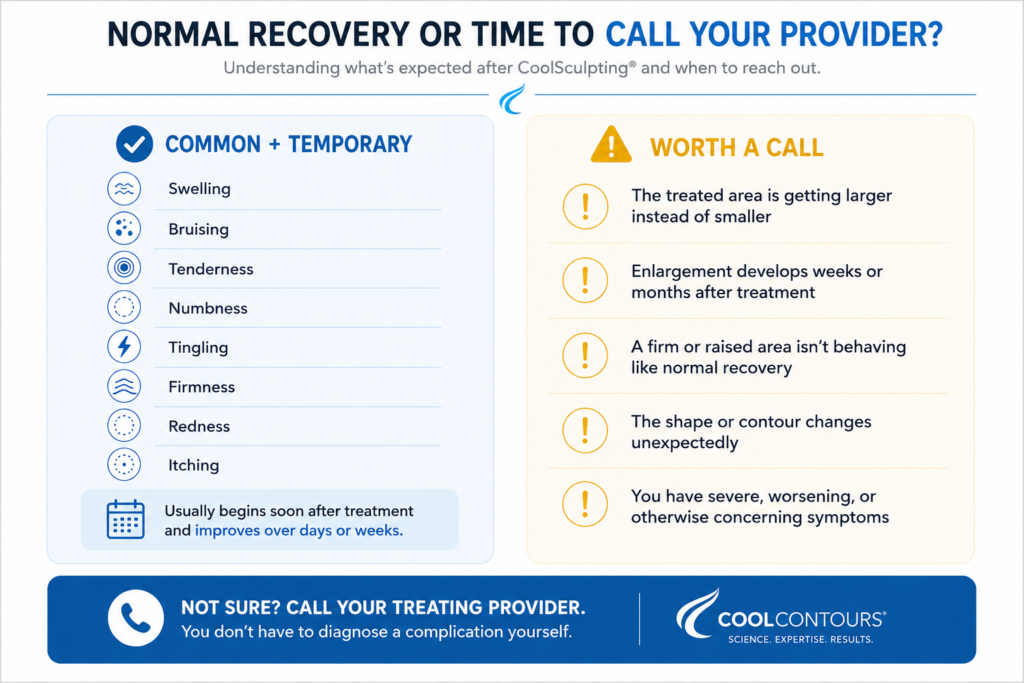
Normal recovery can include temporary firmness, swelling, numbness, tenderness, and other changes.
The difference is usually in the timing and progression.
When Does Paradoxical Adipose Hyperplasia Develop After CoolSculpting?
PAH is a delayed complication.
Current CoolSculpting safety information says it generally develops two to five months after treatment.
The original JAMA Dermatology case report linked above also described gradual enlargement beginning several months after treatment.
So PAH usually doesn’t look like this:
“I was treated yesterday and I’m swollen.”
It is more likely to sound like:
“I was treated a few months ago. At first I thought I was noticing a difference, but now this area seems to be getting larger instead of smaller.”
If that happens, contact the provider who performed your treatment. Don’t try to diagnose PAH yourself from photos online.
Paradoxical Adipose Hyperplasia vs. Normal Swelling After CoolSculpting
This is probably the most important distinction for someone who has recently had treatment.
Normal Recovery
Common temporary effects can include:
- Swelling
- Firmness
- Redness
- Bruising
- Tenderness
- Numbness
- Tingling
- Skin sensitivity
- Itching
These usually begin around the time of treatment or during the following days and gradually improve.
Possible Paradoxical Adipose Hyperplasia
PAH behaves differently.
The treated area:
- Has normal side effects and recovery
- Begins enlarging later
- Typically changes over a period of months
- Becomes more prominent instead of gradually settling
- May develop a distinct contour or shape
- Does not resolve like ordinary post-treatment swelling
The manufacturer specifically states that paradoxical hyperplasia is different from temporary swelling and will not resolve on its own. If you’re still in the early stages of recovery and trying to determine whether what you’re experiencing is expected, start with CoolSculpting Side Effects: What’s Normal and When Should You Be Concerned?.
For the full week-by-week recovery process, read our CoolSculpting Recovery Timeline.
How Common Is PAH After CoolSculpting?
Current CoolSculpting safety information estimates paradoxical hyperplasia at approximately 1 in 3,000 treatments, or 0.033%.
That’s rare, but rare does not mean impossible.
It is also worth understanding why you may see different PAH statistics online.
When PAH first appeared in the medical literature, the 2014 JAMA Dermatology case report estimated the incidence at approximately 0.0051%, based on the information available at the time.
More treatments have been performed and more cases documented since then. The manufacturer’s current estimate is higher.
For patient education today, we use the current manufacturer estimate of 0.033% rather than relying on an older incidence figure.
CoolSculpting also notes that rare adverse events can be difficult to measure because they are reported less frequently.
Has Cool Contours Seen PAH Before?
Yes. Cool Contours is a high-volume CoolSculpting practice, and our team has seen and helped manage PAH cases.
When you perform a large number of treatments over many years, rare events become a numbers game. A 0.033% risk is very small for an individual treatment, but it does not become zero simply because a provider is experienced.
That experience does matter when something unexpected happens.
Our team knows what normal CoolSculpting recovery generally looks like, what deserves a closer evaluation, how a potential PAH case should be documented, and what next steps may be appropriate.
We also think patients deserve to hear about PAH before treatment, not discover that it exists after searching online because they’re worried. That’s why we discuss PH as well as all risks and side effects at every consultation.
Does Choosing a Good CoolSculpting Provider Prevent PAH?
No provider can promise that. And we would be skeptical of anyone who does. A knowledgeable provider can reduce avoidable risk by:
- Screening patients appropriately
- Reviewing medical history
- Identifying contraindications and important considerations
- Evaluating the anatomy before treatment
- Selecting appropriate applicators
- Positioning applicators correctly
- Creating an appropriate treatment plan
- Following manufacturer protocols
- Recognizing an abnormal recovery
- Documenting a complication appropriately
- Helping a patient navigate next steps
But even when a provider does everything appropriately, a rare adverse event can still occur.
That’s an important distinction.
Selecting an experienced provider isn’t about pretending risk doesn’t exist. It’s about having someone qualified on both sides of the treatment: before it happens and if something unexpected occurs afterward.
For a broader discussion of candidacy, contraindications, expected effects, and treatment safety, read Is CoolSculpting Safe?.

What Happens If You Develop Paradoxical Adipose Hyperplasia?
The first step is evaluation and documentation.
Your treating provider needs to determine whether what you’re seeing is consistent with PAH or another post-treatment change.
If PAH is confirmed, it generally requires corrective treatment rather than waiting for it to disappear.
Current CoolSculpting information states that PAH does not resolve on its own and may require surgery.
Published medical literature has also described surgical correction with procedures such as liposuction or abdominoplasty when appropriate.
That can understandably sound scary.
But PAH is primarily a contour problem that has a corrective pathway. A confirmed diagnosis does not mean you’re simply stuck with the enlargement.
The appropriate repair depends on your individual case, anatomy, timing, and the surgeon evaluating you.
What Is the Cool Confidence Program?
CoolSculpting currently references a manufacturer program called Cool Confidence for patients who experience paradoxical hyperplasia. According to CoolSculpting’s current patient information, the program can offer financial assistance toward corrective treatment in eligible cases.
There are two important words there:
eligible cases.
Cool Confidence is not a blanket guarantee that every patient will automatically receive full payment for corrective surgery. Appropriate evaluation, confirmation, and documentation matter.
If PAH is suspected, working with the practice that performed your treatment is important because they have your treatment records and can help navigate the documentation and manufacturer process.
Can PAH Be Repaired With Liposuction?
Liposuction is one of the corrective options that may be considered for PAH.
The original JAMA Dermatology report noted that correction had relied on liposuction or abdominoplasty when treatment was necessary.
But this is not something to self-plan based on an article.
PAH repair requires evaluation by a qualified surgeon who understands the tissue change and can determine the appropriate procedure and timing for your case. We recommend working with a plastic surgeon with experience in CoolSculpting and PH. With appropriate management and an experienced repair surgeon, there is a path forward.
What Other Rare Complications Can Happen After CoolSculpting?
PAH gets most of the attention, but it isn’t the only uncommon adverse event recognized by CoolSculpting.
The current CoolSculpting Elite safety information classifies events occurring in approximately 0.01% to 0.1% of treatments as rare and events below 0.01% as very rare.
We don’t think patients need a frightening checklist of every theoretical possibility.
But you should know that other documented complications exist.
Freeze Burn or Frostbite
A freeze burn is an injury caused by excessive cold exposure.
CoolSculpting’s current safety information estimates freeze burn at approximately 1 in 15,000 treatments, or 0.006%. The manufacturer notes that these injuries typically resolve with appropriate care, although second- and third-degree burns can occur very rarely.
This is different from ordinary redness or sensitivity after treatment.
Unexpected blistering, significant skin changes, or symptoms that concern you deserve prompt contact with your treating provider.
Severe or Delayed Pain
CoolSculpting recognizes both severe pain and late-onset pain among rare adverse events.
Late-onset pain typically begins several days after treatment rather than immediately.
If pain is your primary concern, we’ve covered that separately in Does CoolSculpting Hurt? What Treatment and Recovery Really Feel Like.
Changes in Skin Color
Temporary darkening or lightening of the skin can rarely occur.
The manufacturer’s current information estimates hyperpigmentation or hypopigmentation at approximately 1 in 11,000 treatments, or 0.009%, and notes that it typically resolves spontaneously.
Treatment Area Demarcation
Treatment area demarcation, or TAD, is an uncommon aesthetic outcome in which too much fat reduction creates a visible indentation or interruption in the smooth contour of the surrounding tissue.
The manufacturer estimates it at approximately 1 in 20,000 treatments, or 0.005%.
This is another example of why treatment planning matters.
Reducing fat isn’t the only goal. The goal is creating a balanced contour.
Cold Panniculitis
Cold panniculitis is a rare inflammatory reaction involving fat tissue after cold exposure.
Milder cases may cause redness, swelling, warmth, tenderness, nodules, or a low-grade fever and can resolve without long-term effects. More severe inflammatory responses may require additional medical or surgical care.
Hernia
CoolSculpting can potentially worsen an existing hernia or contribute to a new hernia in or near a treatment site.
The manufacturer classifies this as a very rare event and specifically identifies an existing hernia near the treatment area as something patients should disclose before treatment.
This is one reason a provider should actually examine you before deciding where applicators belong.
Can CoolSculpting Cause Nerve Injury?
There are some area-specific nerve effects documented with treatment beneath the chin and jawline. In our experience, these effects are self-limiting and self-resolving with appropriate management.
Cold exposure in these areas can temporarily affect nerves involved in tongue movement or lower-lip movement. CoolSculpting’s safety information specifically identifies possible tongue deviation after hypoglossal nerve exposure and lower-lip weakness involving the marginal mandibular nerve.
These are not the same thing as the temporary numbness or tingling that patients commonly experience after treatment.
If you notice an unexpected change involving movement, facial symmetry, or another neurologic symptom after treatment, contact your treating provider.
Common Side Effect or Rare Complication?
The easiest distinction is usually how the symptom behaves.
Normal CoolSculpting recovery tends to improve.
Redness fades.
Swelling settles.
Bruising resolves.
Tenderness gets better.
Numbness gradually changes as sensation returns.
Rare complications can behave differently. They may appear later, worsen rather than improve, cause an unexpected change in the contour or skin, or simply not follow the recovery your provider described.
You don’t need to know the medical name for what you’re seeing before you call.
If something concerns you, call your treating provider.
When Should You Contact Your CoolSculpting Provider?
Reach out if:
- The treated area begins getting larger rather than smaller
- You notice a new contour change months after treatment
- Pain is severe or getting worse
- You notice significant or unexpected skin changes
- You develop a symptom your provider didn’t prepare you for
- Something isn’t improving the way you expected
- You’re simply worried
That last reason is enough.
You don’t have to decide whether something qualifies as a complication before asking for help.
Already Had CoolSculpting and You’re Concerned about Paradoxical Adipose Hyperplasia?
If Cool Contours Performed Your Treatment
Contact our team.
We know your treatment history, which areas and applicators we used, and your treatment plan. That context allows us to help determine the appropriate next step.
If Another Practice Performed Your Treatment
Please contact the provider who treated you.
They have your records and need to evaluate and manage complications related to the treatment they performed.
Cool Contours cannot diagnose or manage a possible complication from a CoolSculpting procedure performed at another facility.
Frequently Asked Questions About Paradoxical Adipose Hyperplasia and CoolSculpting Risks
Paradoxical adipose hyperplasia, or PAH, is a rare complication in which fatty tissue in a CoolSculpting treatment area becomes larger instead of smaller.
CoolSculpting currently reports paradoxical hyperplasia in approximately 1 out of 3,000 treatments, or 0.033%.
The manufacturer says PAH typically develops approximately two to five months after treatment.
PAH is generally a delayed complication. Swelling and firmness immediately after treatment are common temporary effects and are different from PAH.
Current CoolSculpting safety information states that PAH does not resolve on its own and may require corrective surgery.
Liposuction has been used to correct PAH, as has abdominoplasty in some cases. The appropriate treatment depends on the individual patient and should be determined by a qualified surgeon.
CoolSculpting currently offers the Cool Confidence program, which may provide financial assistance toward corrective treatment in eligible cases. It is not an automatic guarantee of coverage.
No provider can guarantee that PAH or another rare complication will never occur.
Experience does matter for patient selection, treatment planning, appropriate device use, recognizing abnormal recovery, documenting a complication, and helping patients navigate their next steps.
Not necessarily.
Temporary firmness is common immediately after CoolSculpting. PAH typically appears later and causes progressive enlargement of the treated area.
If you’re unsure, contact your treating provider rather than trying to diagnose the area yourself.
CoolSculpting has a well-established safety profile and more than 17 million treatments have been performed worldwide, but it is still a medical treatment with contraindications, common side effects, and rare complications.
For the broader safety discussion, read Is CoolSculpting Safe?.
Considering CoolSculpting and Worried About Rare Risks like Paradoxical Adipose Hyperplasia?
We understand why PAH gets attention.
If you’re going to choose an elective treatment, you should know the benefits and the risks before you decide.
At Cool Contours, we’ll review your medical history, evaluate your anatomy, talk through common side effects and rare complications, and determine whether CoolSculpting makes sense for what you’re trying to accomplish.
We won’t tell you a complication is impossible.
We’ll tell you what we know, what the actual risks look like, and what happens if something unexpected occurs.
You can also:
- Review real CoolSculpting results
- Read Is CoolSculpting Safe?
- Learn about CoolSculpting side effects
- Review the CoolSculpting recovery timeline
- Read the manufacturer’s official CoolSculpting safety information
- Review the original JAMA Dermatology report on paradoxical adipose hyperplasia
